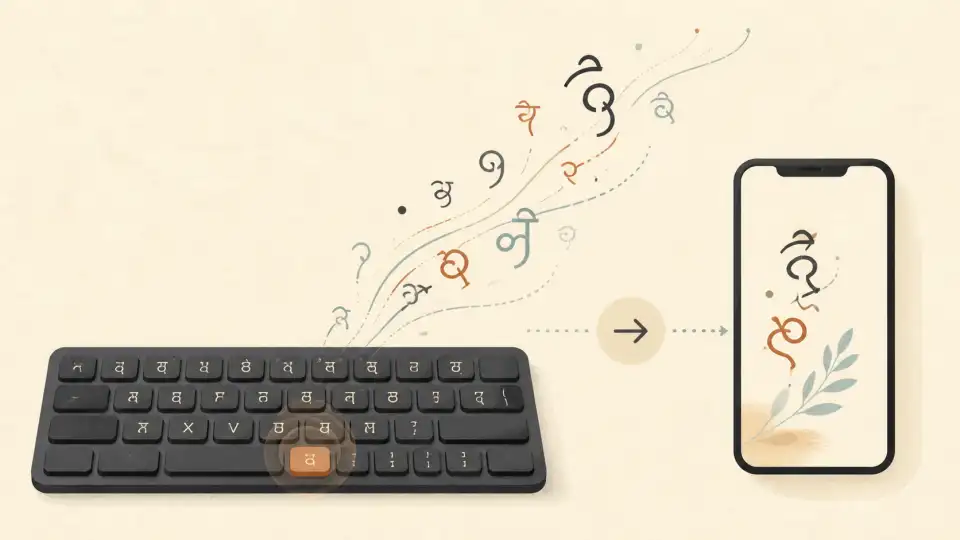
Malayalam is a notoriously heavy script. With its intricate, looping characters and complex subscript conjunctions (Koottaksharangal), assigning all these symbols to a tiny physical keyboard creates a maze nobody wants to navigate.
The salvation for the modern Malayalam writer is Manglish (Malayalam + English). By typing phonetically, software algorithms handle the heavy lifting of rendering the native script.
But Manglish is not perfect. (For a deep dive into using it for formal correspondence, read our Complete Guide to Malayalam Writing Online). Translating English sounds into Malayalam requires understanding how phonetic mapping actually handles subtle linguistic differences.
Understanding the Mechanics of Phonetic Typing
When you use a tool like the Sariya Manglish Converter or native OS transliteration, the engine relies on predictive sequences.
- Swarangal (Vowels): Typing 'a' outputs 'അ'. Typing 'aa' outputs 'ആ'.
- Vyanjanangal (Consonants): Typing 'ka' outputs 'ക'. Typing 'kha' outputs 'ഖ'.
The Trap of Context-Dependent Letters
The biggest hurdle in Manglish conversion is Malayalam's vast array of similar-sounding letters. English phonetics are too limited to accurately map them 1:1.
The Three N's (ന, ண, ണ)
If you type "Panam" in a simple converter, the tool does not know if you mean "പനം" (Palm) or "പണം" (Money). Without AI contextual awareness, the transliterator will guess blindly, leading to embarrassing sentence structures on official social media posts.
The Two L's (ല, ള)
Similarly, typing "Kalyanam" (Marriage) might result in "കല്യാണം" (correct) or "കള്യാണം" (incorrect), depending on entirely on how the predictive engine weights the word frequency.
Mastering the Koottaksharangal (Conjuncts)
How do you type subscript letters where one consonant hangs below another?
The phonetic rule: Type the two consonants together without a vowel in between.
- To get 'ക്ല' (kla): Type
k+l+a. - To get 'പ്ര' (pra): Type
p+r+a.
If you insert a space or a vowel where it doesn't belong, the letters will split apart, destroying the word.
Review Before Publishing
If you are a student or a professional, you should never copy-paste blindly from a phonetic transliterator. Always funnel the resultant output through an AI Malayalam Grammar Checker to algorithmically scrub out the 'Na/Nna' and 'La/Lla' mapping errors caused by standard digital keyboards.
Frequently Asked Questions
What is Manglish?
Manglish is the practice of phonetic typing—using the English alphabet to spell out Malayalam words based on how they sound (e.g., 'namaskaram'). It is globally used by the Kerala diaspora.
Why does my Manglish translator output the wrong letter?
Basic translators struggle with Malayalam's subtle variations, like 'ല' (La) vs 'ള' (Lla). If you type 'Na', the engine might not know if you want 'ന', 'ண', or 'ണ' without advanced AI context processing.
How do I type double consonants in Manglish?
To create a double consonant (Koottaksharam), you simply type the English letter twice. For example, typing 'Amma' automatically outputs 'അമ്മ'.